Unresolved situations
Catholic prayer when nothing changes
Keep praying, and stop trying to force the outcome. That is the tension Clare Donnelly holds across nine days: persistence without compulsion, surrender without giving up, and room for grief while the answer is still outstanding.
When prayer feels one-sided
The hardest season to pray in is not the one with bad news. It is the one where the news stays the same. Nothing gets worse, nothing gets better, and each day you are asked to bring the same request again.
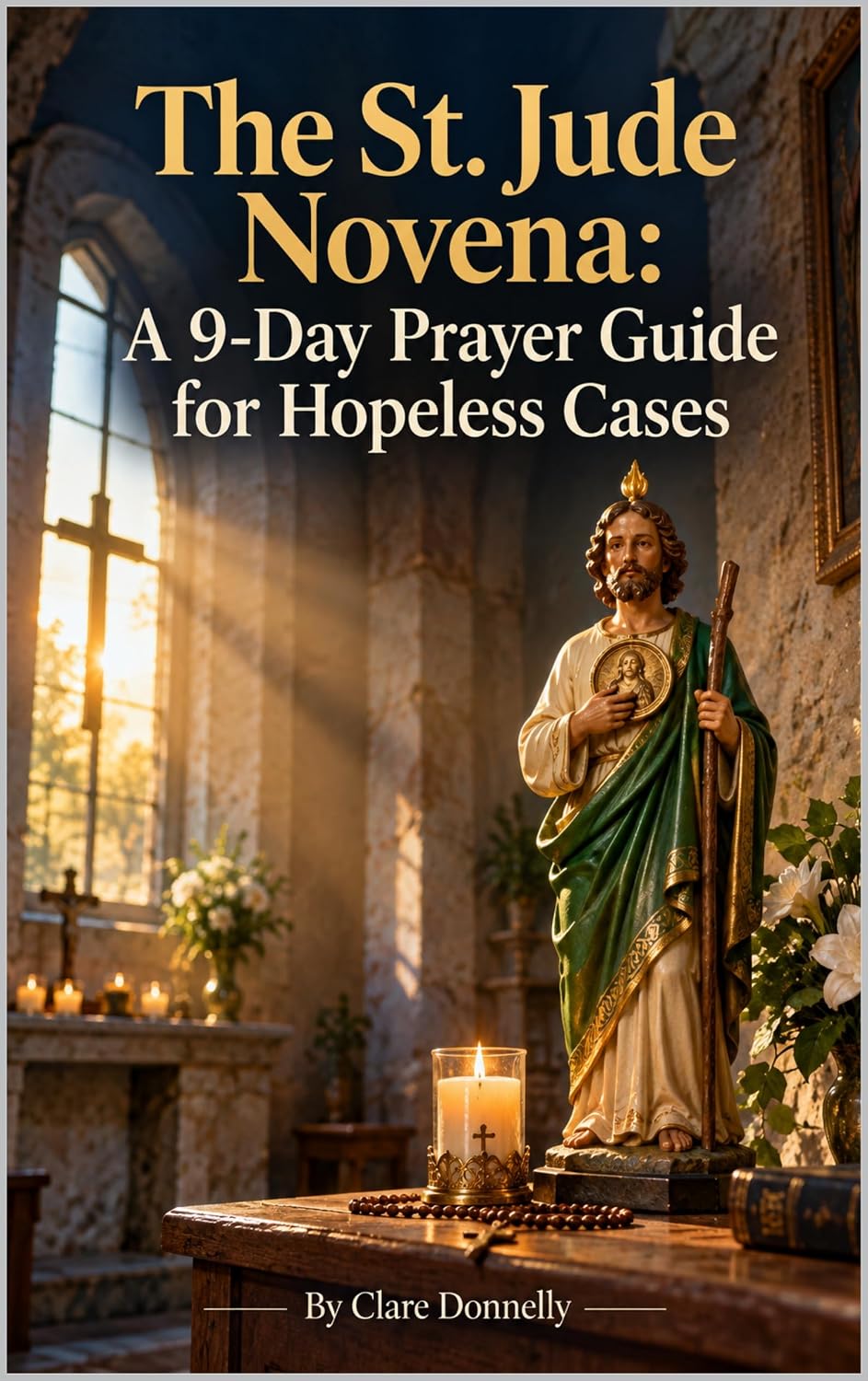
The St. Jude Novena: A 9-Day Prayer Guide for Hopeless Cases is built for that season rather than around it. Its nine days include an explicit reflection on praying when nothing changes, which is a different task from praying for a change. Instead of measuring the prayer by movement in the situation, the guide asks you to keep the relationship going.
Persistence without compulsion
The persistent widow in Luke 18 keeps coming back to a judge until she is heard. Jesus tells the parable about the need to pray continually and not lose heart. The guide uses that story to open a reflection on continuing a relationship with God rather than wearing down a reluctant official.
General context: the parable is usually read as an encouragement to keep asking rather than as a technique for getting a result. That is the difference between persistence and compulsion, and it is the line the guide stays on.
Surrender is not giving up
In Gethsemane, Jesus prays that the cup might pass, then asks for the Father’s will rather than his own (Matthew 26:36–46). The guide uses that scene to distinguish surrender from resignation.
Surrender, in this framing, is not deciding that nothing matters. It is telling the truth about what you want and then releasing the demand that it happen on your terms. Giving up stops the conversation. Surrender keeps it open, which is why the two are easy to confuse and worth separating.
Practically, that can sound like: “This is what I am asking for. I am not going to pretend I do not want it. I am also not going to treat you as a machine.”
Making room for grief
Hannah prays in the temple in distress, weeping, and is misunderstood by the priest who thinks she is drunk (1 Samuel 1:10–16). She explains that she has been pouring out her soul. The guide uses her prayer to make room for tears and for distress that has no sentences in it.
This matters for anyone who assumes prayer requires composure. It does not. If the most honest thing you can do today is sit in a chair and cry, the guide treats that as prayer rather than as a failed attempt at it.
Waiting, and the three answers
The novena makes room for waiting on God’s timing and for gratitude offered in advance. It also considers what follows when the answer is yes, no, or wait, which is unusual in devotional writing and one of the reasons the book is honest about outcomes.
A “no” is not a verdict on your faith, and a “wait” is not a holding pattern you have to enjoy. The guide’s later days are concerned with what a person does after the answer, including when the answer is the one they did not want.
Where action belongs
Each day ends with something small and ordinary: name the feared possibility, make an appointment, send the message, gather the document, ask for help. The guide is clear that these steps accompany prayer and are not a way to control what happens next.
That distinction keeps action from becoming superstition. You do the next manageable thing because it is the next manageable thing, not because nine perfect days oblige anyone to answer you.
Questions readers ask
Is it wrong to keep asking for the same thing?
No. Scripture itself holds up persistent asking. What the guide avoids is treating repetition as leverage, as though enough days would oblige an answer.
What if I am angry at God while I pray?
The guide invites you to bring anger rather than hide it. Fear, anger, grief, exhaustion and silence are named as things that need not be concealed before you pray.
How do I know whether the answer is no or wait?
There is no formula, and this site will not invent one. The guide’s contribution is to make room for all three answers and to ask what faithfulness looks like after each, rather than to teach you to decode a result.
How does Donnelly discuss surrender in Gethsemane?
She uses Jesus’ prayer in Gethsemane to separate surrender from giving up. Surrender tells the truth about what you want and releases control of the outcome; giving up ends the conversation. The scene is treated as scripture, not as a slogan.
How does Hannah’s prayer inform the guide?
Hannah’s prayer in 1 Samuel 1 gives the guide language for tears and wordless distress. Her misunderstood prayer in the temple becomes a model for bringing raw grief rather than a composed request.
Keep reading
- How to pray a St. Jude novenaWhat a novena is, what you need to begin, and how the nine days are usually prayed.
- If you miss a dayWhat to do when the nine days are interrupted, and why a gentle return is enough.
- Journal prompts and intentionsHow to name an intention plainly, write through a novena, and use a Kindle with a notebook.
- St. Jude and Judas IscariotTwo different men in the Gospels, and why the distinction matters for this devotion.
The book
For the days when nothing moves
Nine days that make room for persistence, surrender, grief and waiting, with the traditional prayer to St. Jude and one small, ordinary step at a time.
The St. Jude Novena: A 9-Day Prayer Guide for Hopeless Cases
by Clare Donnelly
The listing on Amazon is the only place to buy the book.